For women who learned to stay agreeable at the expense of themselves.
People pleasing was not your personality. It was what felt safest at the time.
Understand why saying no still feels risky, even when you know better.
√ Say no without panic
√ Stop monitoring everyone else
√ Feel like yourself again
√ Say no without panic
√ Stop monitoring everyone else
√ Feel like yourself again
What if the way you’ve been showing up wasn’t a choice, but the only way that felt safe?
You say “it’s fine” when it isn’t, because the truth feels risky.
You give so much of your time and energy that you start to feel invisible in your own life.
You second-guess yourself, then over-explain like you’re on trial for having needs.
You smile through resentment and apologize for wanting more than what’s being offered.
And deep down, you wonder:
“Do they like me, or just the version of me that keeps things comfortable?”
This doesn’t live in one corner of your life.
It runs through all of it.
At work, you take on the extra project because it’s easier than the awkwardness, disappointment, or tension that follows.
With family, you host a function again because saying no would “start something.”
With friends, you agree to plans you dread and quietly hope they cancel.
In relationships, you swallow what you need so you won’t be seen as too much — too emotional, too needy, too difficult.
You didn’t imagine this.
And you didn’t choose it without a reason.
This is what happens when staying agreeable feels safer than being fully yourself.


Hi, I’m Kala Myles — founder of One Up Your Level.
I know what it’s like to agree to something and feel the anxiety hit as the words leave your mouth, while already calculating how tired you’ll be while saying, “Yeah, that’s fine.”
Not because you weren’t paying attention.
Not because you didn’t care about yourself.
But because in that moment, staying agreeable felt safer than dealing with the tension that might follow.
For a long time, I thought the problem was confidence.
Or boundaries.
Or not being “strong enough” to handle discomfort.
But what I saw, in my own life and in the lives of countless women since, is that the fear shows up before choice does.
Most advice assumes you have access to calm, rational decision-making in those moments.
I don’t assume that and I don’t ask women to ignore their fear or talk themselves out of what their body is signaling.
What changes when you stop surviving and start being you?
When you’re no longer organizing your life around fear, your inner world starts to change first.
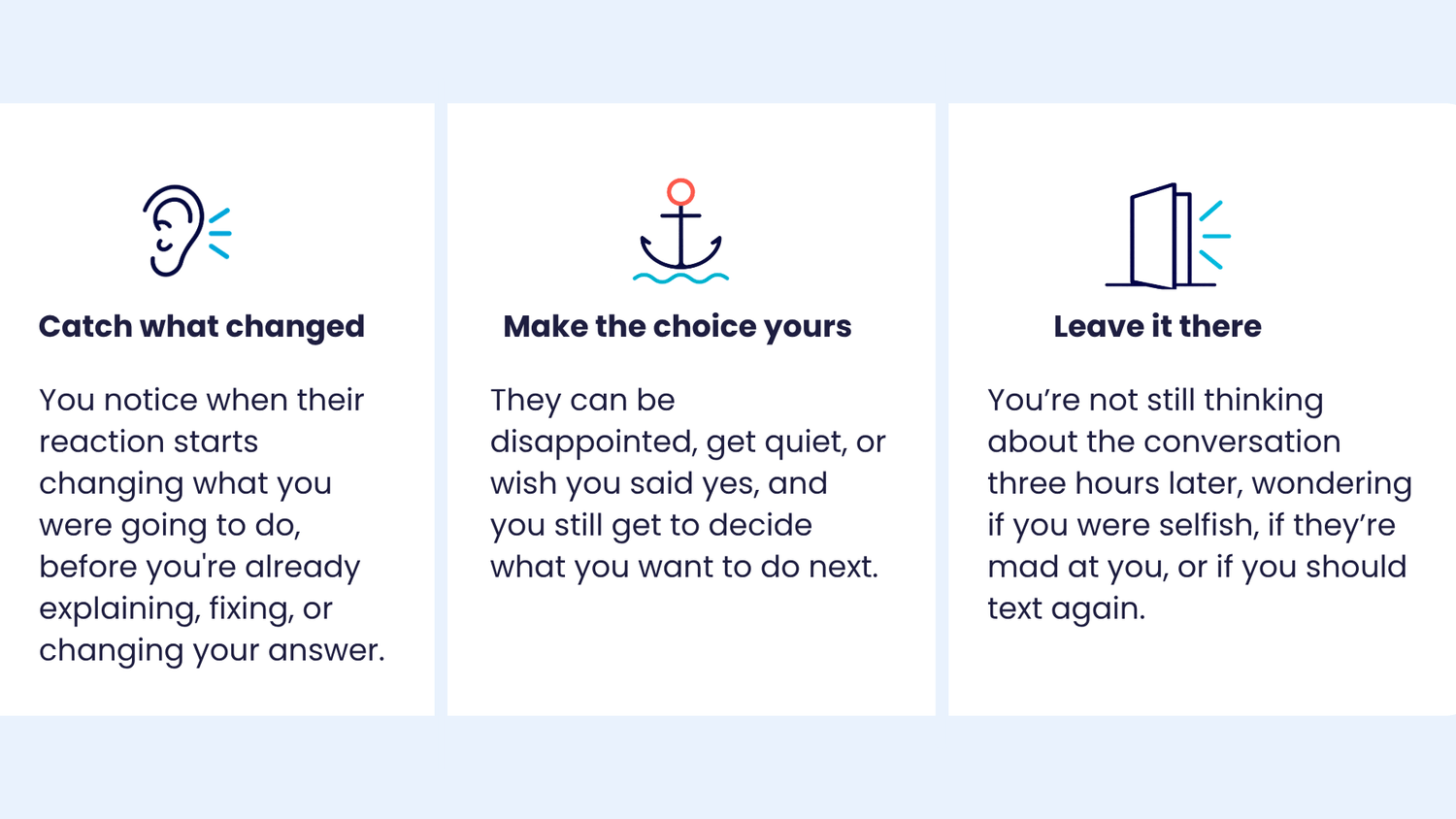
You stop explaining yourself just to feel allowed to choose.
You don’t rehearse conversations before you’ve even had them.
You don’t keep adding reasons so no one gets uncomfortable.
→ You make a decision without running it through someone else’s reaction first.
Why this becomes possible:
Because we work with the fear that shows up before the decision, not the behavior after it.
You’re not watching their face to see if you said something wrong.
You’re not replaying your words mid-conversation, trying to fix them in real time.
You’re not softening, backtracking, or adding extra explanation to keep things from escalating.
→ You’re not carrying the moment by managing how the other person reacts.
Why this becomes possible:
Because your nervous system no longer treats disagreement or disappointment as a threat.
You don’t tense up when a request comes up.
You don’t feel rushed to answer just to make the discomfort stop.
You don’t hear yourself say “yeah, that’s fine” before you’ve even decided.
→ You can pause without it feeling dangerous to do so.
Why this becomes possible:
Because your body stops treating requests like something you have to do to survive.

There’s a reason saying no feels so hard.
And it’s not because you’re weak, unclear, or failing in some hidden way.
Read a short, grounded breakdown of why your body reaches for “yes” before you’ve had time to choose.
Understand what your nervous system is responding to in the moment and why insight alone never stopped it.
What you’ve been feeling gets language, context and relief — without diagnosing or blaming you.
Why most advice doesn’t stick.
Most advice sounds fine when you’re reading it.
Then you’re actually in the moment and your body does the exact opposite of what the advice promised it would.
You try to “push past it.”
You try to be positive.
You try to say the thing you practiced.
And when it doesn’t work, you’re left wondering what’s wrong with you.
No wonder it never sticks.
And no wonder it feels awful every time you hear it.
The problem was never a lack of effort or motivation.
The advice didn’t match what was actually happening in your body.

What you’ll understand before anything changes:

A Clear Starting Point
A short, focused breakdown of what’s happening in your body and mind right before you say yes — without personality labels or surface-level advice.

The Pattern That Takes Over Under Pressure
A clear explanation of the learned pattern that shows up when tension, disappointment, or conflict feels possible — and why it still runs automatically.

Why "Knowing Better" Hasn't Helped
A grounded explanation for why insight, awareness and good intentions haven’t stopped the automatic yes — even when you understand the issue.

What's Triggering The Reaction
Clarity on what your system is reacting to in the moment — before choice, reasoning, or decision-making come online.

Language That Fits Your Experience
Clear, accurate language for what you’ve been experiencing — without blame, shame, or being framed as broken.

A Grounded Starting Point
A steady understanding of what’s happening beneath the pattern, before boundaries, communication strategies, or behavior change are even on the table.
Frequently Asked Questions
Most women who take the quiz already know something isn’t working.
What they don’t know is why saying yes feels automatic, or why awareness alone never changed it.
This quiz doesn’t give advice or tell you what you should do differently.
It shows you what your body is reacting to before you decide.
When that part finally makes sense, the pattern stops feeling personal and that’s usually where the relief starts.
No.
This isn’t about pushing through fear, confronting anyone, or changing how you show up overnight.
The quiz is about understanding what’s happening inside you in the moment before you say yes, not what you’re supposed to do next.
Nothing changes unless you decide it should.
What often gets labeled as “selfish” is simply not organizing yourself around other people’s comfort.
If you’ve spent years staying agreeable, available and easy to be around, any moment of checking in with yourself can feel wrong, even when you’re exhausted.
This isn’t about putting yourself first at someone else’s expense.
It’s about staying connected to yourself without editing who you are to keep the peace.
Most advice starts at the point of behavior — what to say, how to say it, how to ‘hold the boundary.’
This starts earlier.
It looks at what happens in your body before you decide, the tension, the urgency, the fear of reaction, the part that makes advice impossible to use in real time.
When that reaction finally makes sense, you’re no longer fighting yourself or blaming yourself just to get through the moment.
You answer a short set of questions about what happens right before you say yes.
You'll see:
The specific survival role you slip into under pressure.
Why your reaction feels automatic.
What your body is trying to protect you from.
Your time, your energy, your voice, your body. This breaks down why your yes shows up automatically and why stopping has felt harder than it should.
One Up Your Level | © 2026 All Rights Reserved